A raised plank supports your hands on a sturdy counter, bench or table while your feet remain on the floor. It is more demanding than a wall plank but usually more approachable than starting on the floor.
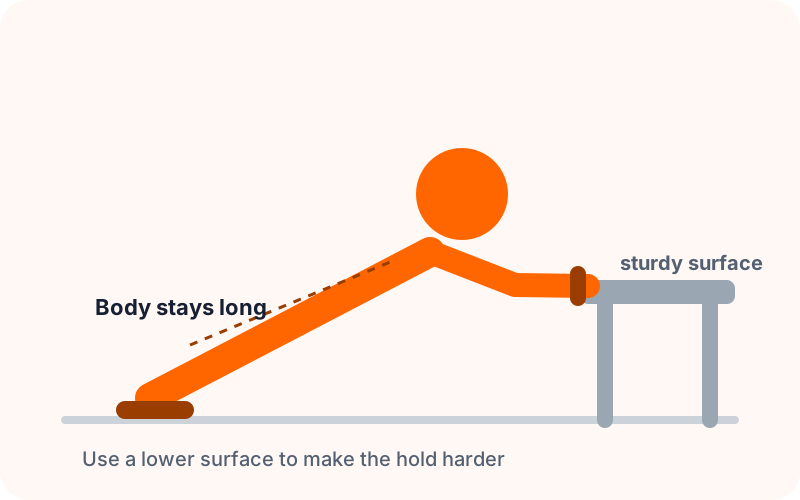
Set up a raised plank step by step
- Choose a sturdy surface that will not move, tip or slide.
- Place your hands around shoulder width apart.
- Walk your feet back until your body forms a long inclined line.
- Keep your hands beneath or slightly ahead of your shoulders.
- Gently tighten your stomach and buttocks while breathing normally.
- Press into the surface and hold for 15 seconds.
- Walk your feet forwards to finish.
What should it feel like?
Expect work through your abdomen, shoulders, arms and buttocks. Your body should feel connected rather than folded at the hips.
Stop if you feel sharp pain, pinching or numbness. If the position repeatedly causes pain, ask a qualified health or fitness professional for an appropriate variation.
Make it easier or harder
Use a higher surface or move your feet slightly closer to make the hold easier. Use a lower sturdy surface to make it harder.
Change only one thing at a time. The surface must support your weight safely; avoid lightweight furniture or anything with wheels.
Common raised-plank mistakes
Choosing an unstable surface
Stability comes first. A heavy counter or fixed bench is a better choice than a chair that might slide.
Leaving the hips behind
Walk your feet back and move your shoulders, hips and heels together as one long line.
Letting the shoulders collapse
Press the surface away rather than sinking between your shoulders.
Chasing a lower surface too quickly
A lower plank is not better if the position falls apart. Stay at the height you can control.
A simple first session
Hold for 15 seconds, rest for 15 - 30 seconds, then repeat once or twice. Finish while you can still breathe and maintain the same position.
FAQ
What is a raised plank?
A raised plank is a straight-arm plank with your hands supported on a sturdy counter, bench or similar raised surface. It sits between a wall plank and a floor plank in difficulty.
How high should the surface be?
Start with a surface high enough that you can hold a long body position and breathe normally for 15 seconds. A higher surface is generally easier and a lower surface is harder.