B1-B2 Bokmål for the bakery counter
Norwegian Buns And Bakery Vocabulary
A Norwegian bakery display can teach you far more than the word bolle. Learn to recognize classic buns, describe their fillings and textures, understand regional names, and order the one you actually want.
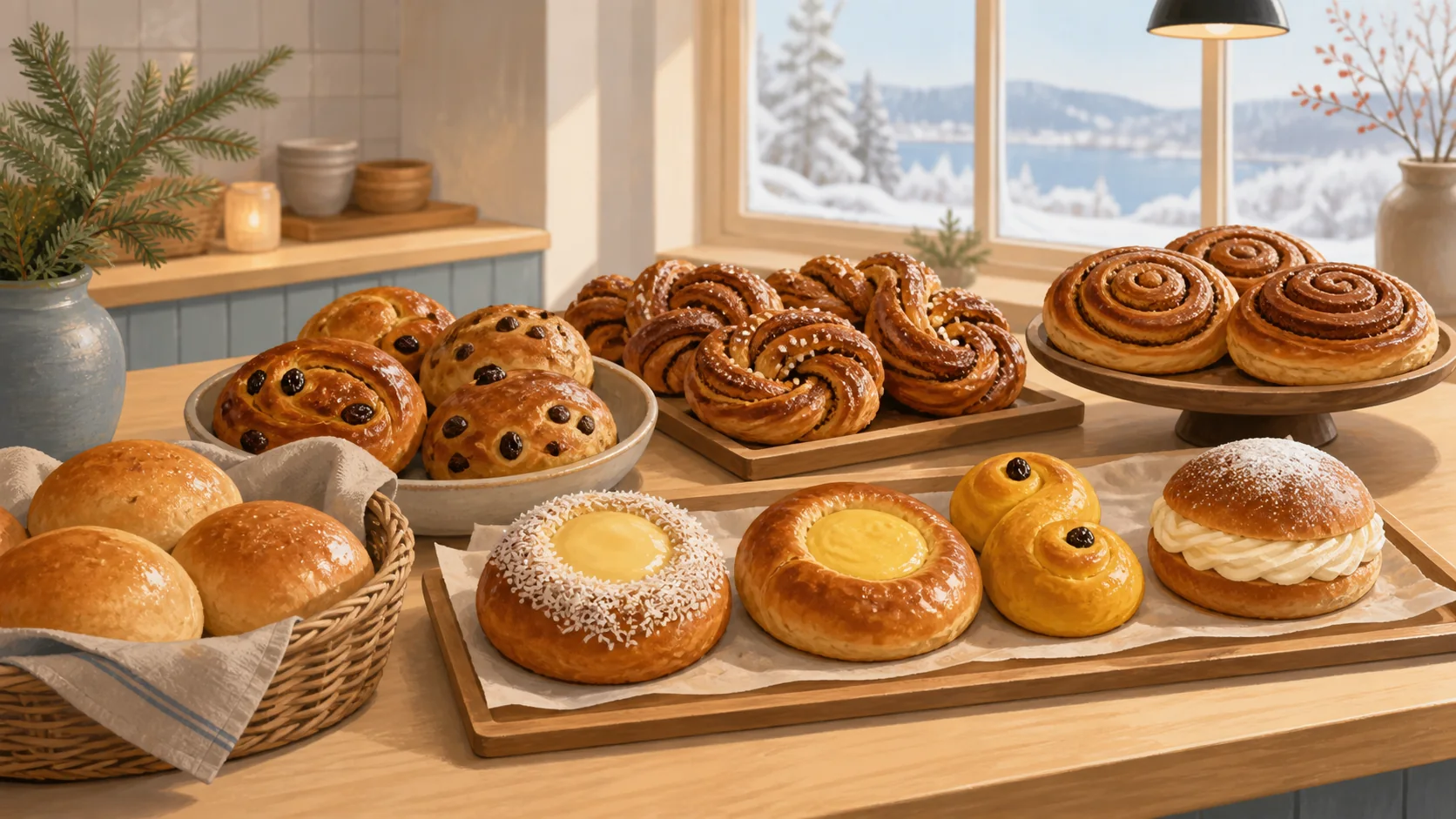
Bolle, Bakverk And Gjærbakst
En bolle is one bun; boller is the plural. Et bakverk is a broader word for something baked, while gjærbakst means yeast baking or yeast-baked goods. At a bakery, you may hear all three words, but bolle is the useful starting point when the display is full of sweet, soft buns.
Learn the whole guide over time
Add this guide once. Learnalist introduces new cards gradually and brings them back for review. A free account is needed.
Start at the display case
Classic Norwegian Buns
Learn the names of common buns and recognize the details that distinguish them.
English
a sweet wheat bun
Norwegian
en hvetebolle
English
a raisin bun
Norwegian
en rosinbolle
English
a chocolate-chip bun
Norwegian
en sjokoladebolle
English
a cinnamon bun
Norwegian
en kanelbolle
English
a twisted cinnamon bun
Norwegian
en kanelsnurr
English
a cinnamon knot
Norwegian
en kanelknute
English
a skillingsbolle
Norwegian
en skillingsbolle
English
a custard bun with icing and coconut
Norwegian
et skolebrød / en skolebolle
English
a bun with custard
Norwegian
en solskinnsbolle
English
sweet yeast baking
Norwegian
søt gjærbakst
What is inside?
Ingredients, Fillings And Toppings
Name the flavors and finishing touches you are likely to see on Norwegian buns.
English
cardamom
Norwegian
kardemomme
English
cinnamon
Norwegian
kanel
English
custard
Norwegian
vaniljekrem
English
icing
Norwegian
melisglasur
English
desiccated coconut
Norwegian
kokosmasse
English
raisins
Norwegian
rosiner
English
chocolate chips
Norwegian
sjokoladebiter
English
whipped cream
Norwegian
pisket krem
English
jam
Norwegian
syltetøy
English
almond paste
Norwegian
mandelmasse
Useful B1-B2 language
Describe A Bun
Describe texture, freshness, fillings, and toppings instead of relying on the English name.
English
It is light and fluffy.
Norwegian
Den er lett og luftig.
English
It is soft on the inside.
Norwegian
Den er myk inni.
English
It is slightly crisp on the outside.
Norwegian
Den er litt sprø utenpå.
English
It is sweet and sticky.
Norwegian
Den er søt og klissete.
English
It tastes of cardamom.
Norwegian
Den smaker av kardemomme.
English
It is filled with custard.
Norwegian
Den er fylt med vaniljekrem.
English
It is topped with icing.
Norwegian
Den er toppet med melisglasur.
English
It is sprinkled with coconut.
Norwegian
Den er drysset med kokosmasse.
English
It is freshly baked.
Norwegian
Den er nybakt.
English
This one is not as sweet.
Norwegian
Denne er ikke like søt.
At the bakery counter
Order And Ask Questions
Use polite, natural phrases to choose a bun, ask about ingredients, and say where you will eat it.
English
Could I have one cinnamon bun, please?
Norwegian
Kan jeg få en kanelbolle, takk?
English
I would like two school buns.
Norwegian
Jeg vil gjerne ha to skoleboller.
English
What is this one called?
Norwegian
Hva heter denne?
English
What is it filled with?
Norwegian
Hva er den fylt med?
English
Does it contain nuts?
Norwegian
Inneholder den nøtter?
English
Do you have anything without milk?
Norwegian
Har dere noe uten melk?
English
Which bun do you recommend?
Norwegian
Hvilken bolle anbefaler du?
English
Was it baked today?
Norwegian
Ble den bakt i dag?
English
I will eat here.
Norwegian
Jeg spiser her.
English
Could I have it to take away?
Norwegian
Kan jeg få den med meg?
Put the phrases together
A Short Bakery Dialogue
Practise a complete exchange from asking for advice to paying for your order.
English
Customer: Hi! What do you recommend?
Norwegian
Kunde: Hei! Hva anbefaler du?
English
Staff: The cinnamon buns are freshly baked.
Norwegian
Ansatt: Kanelsnurrene er nybakte.
English
Customer: Are they very sweet?
Norwegian
Kunde: Er de veldig søte?
English
Staff: No, but they have plenty of cinnamon.
Norwegian
Ansatt: Nei, men de har mye kanel.
English
Customer: Then I will have one of those and a school bun.
Norwegian
Kunde: Da tar jeg en sånn og en skolebolle.
English
Staff: Will you eat here or take them with you?
Norwegian
Ansatt: Skal du spise her eller ta dem med?
English
Customer: I will take them with me, please.
Norwegian
Kunde: Jeg tar dem med, takk.
English
Staff: Would you like anything to drink?
Norwegian
Ansatt: Vil du ha noe å drikke?
English
Customer: A black coffee, please.
Norwegian
Kunde: En svart kaffe, takk.
English
Staff: That will be 118 kroner.
Norwegian
Ansatt: Det blir 118 kroner.
One bun, several names
Regional Names Are Part Of The Vocabulary
A bun may have more than one familiar name. Cinnamon buns are sold as kanelboller, kanelsnurrer, or kanelknuter, depending on their shape and the bakery. Skillingsbolle is especially associated with Western Norway and Bergen, although you can meet the word elsewhere.
The custard bun decorated with icing and coconut is commonly called both skolebrød and skolebolle. It also has more local names. You do not need to memorize every variant: recognize the common names, then ask Hva heter denne? when the display introduces you to another.
Further reading: Store norske leksikon on boller and Visit Norway on Norwegian baked goods.
Seasonal bakery Norwegian
Some Buns Arrive With The Calendar
En lussekatt
A yellow saffron bun, often curled into an S shape and decorated with raisins. It is strongly connected with Saint Lucy's Day in December.
En fastelavnsbolle
A bun split and filled with whipped cream, often with jam or almond paste. You see it around fastelavn, before Lent.
Beyond Buns At The Bakery Counter
Once you know the buns, widen your bakery vocabulary. A kringle is shaped or twisted baking that may have a sweet filling. Wienerbrød is laminated Danish-style pastry, and eplekake is apple cake. You may also meet vafler and lefse in cafés, bakeries, markets, and traditional food shops.
A useful category note
Vafler are cooked in a waffle iron, and many kinds of lefse are cooked on a griddle. They belong in a guide to Norwegian treats, but not everything at the counter is technically oven-baked.
How To Practise At B1 - B2
- Step 1Add the bakery guide once for gradual learning and review. Connect the bun names you learn to visible ingredients and shapes.
- Step 2Describe a bun without naming it: Den er fylt med vaniljekrem og drysset med kokosmasse.
- Step 3Practise one complete order, including a question and whether you will eat in or take away.
- Step 4At a real bakery, notice the words on the display and save only the new phrases you want to use again.
FAQ
What is the Norwegian word for a bun?
A bun is en bolle, and the plural is boller. Sweet buns made with yeast can also be described collectively as søt gjærbakst.
What is the difference between skolebrød and skolebolle?
Both names can describe the Norwegian custard bun with icing and coconut. Which name people use varies by region and personal habit.
Are kanelbolle, kanelsnurr, kanelknute, and skillingsbolle the same thing?
They all belong to the cinnamon-bun family, but shape and local usage vary. Skillingsbolle is especially associated with Western Norway and Bergen.
How do I order a bun in Norwegian?
Say Kan jeg få en kanelbolle, takk? to ask for a cinnamon bun, or Jeg vil gjerne ha to skoleboller to ask for two school buns.